When sizing a drone or eVTOL,
how do you derive battery performance?

The airframe spec only states takeoff mass, endurance and similar targets; the cell datasheet only gives measured C-rate and energy-density curves — and the conversion that joins the two is written down nowhere. eVTOL Battery Estimator makes it a chain you can re-run and audit.

Download installer See a sample PDF report ¥600 / licence · perpetual Single portable .exe — no installer needed
Fully offline · no network, no uploads Bilingual UI and reports Metric / imperial toggle PDF reports · CSV export
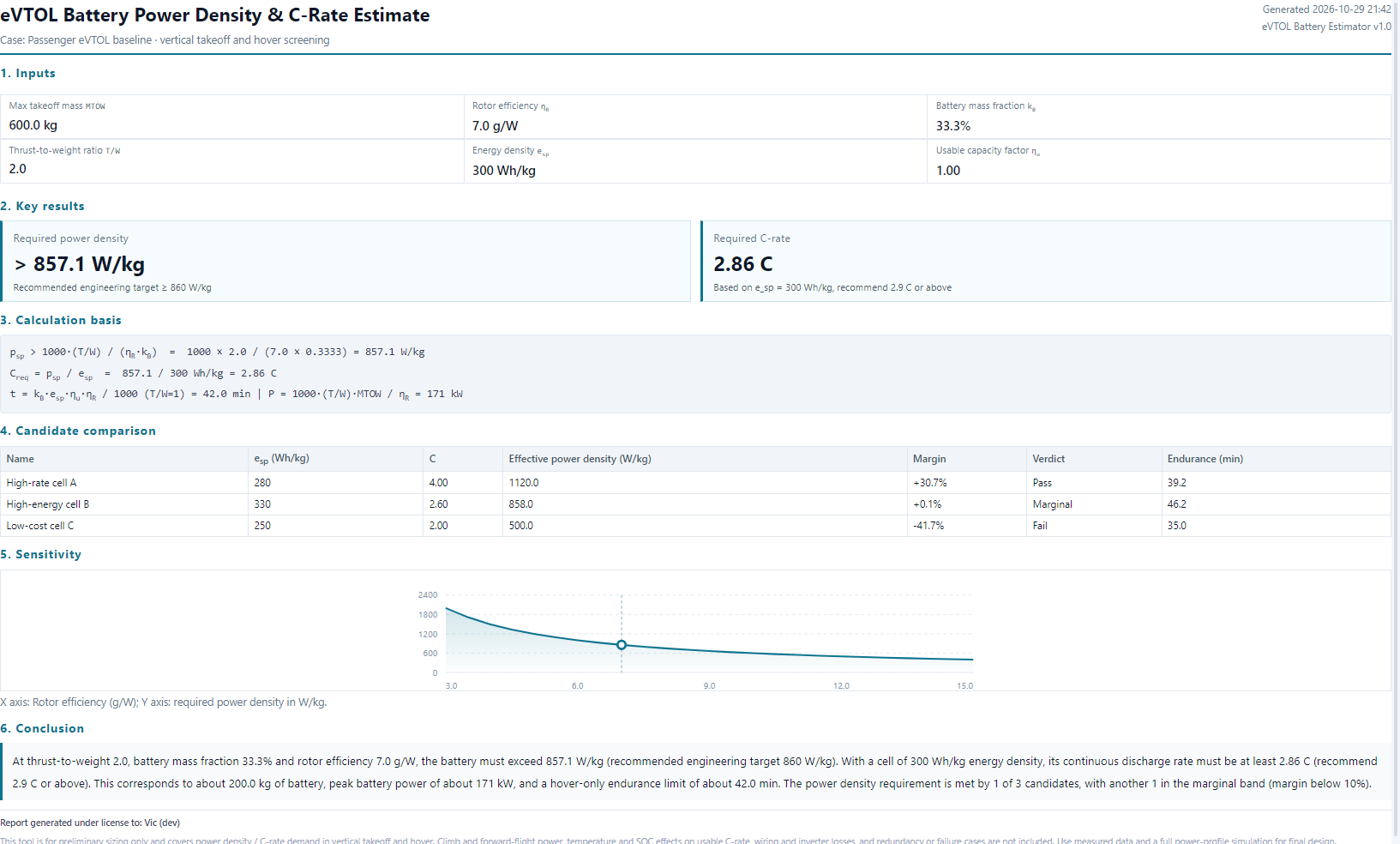
eVTOL Battery Power Density Estimator · 600 kg passenger baseline
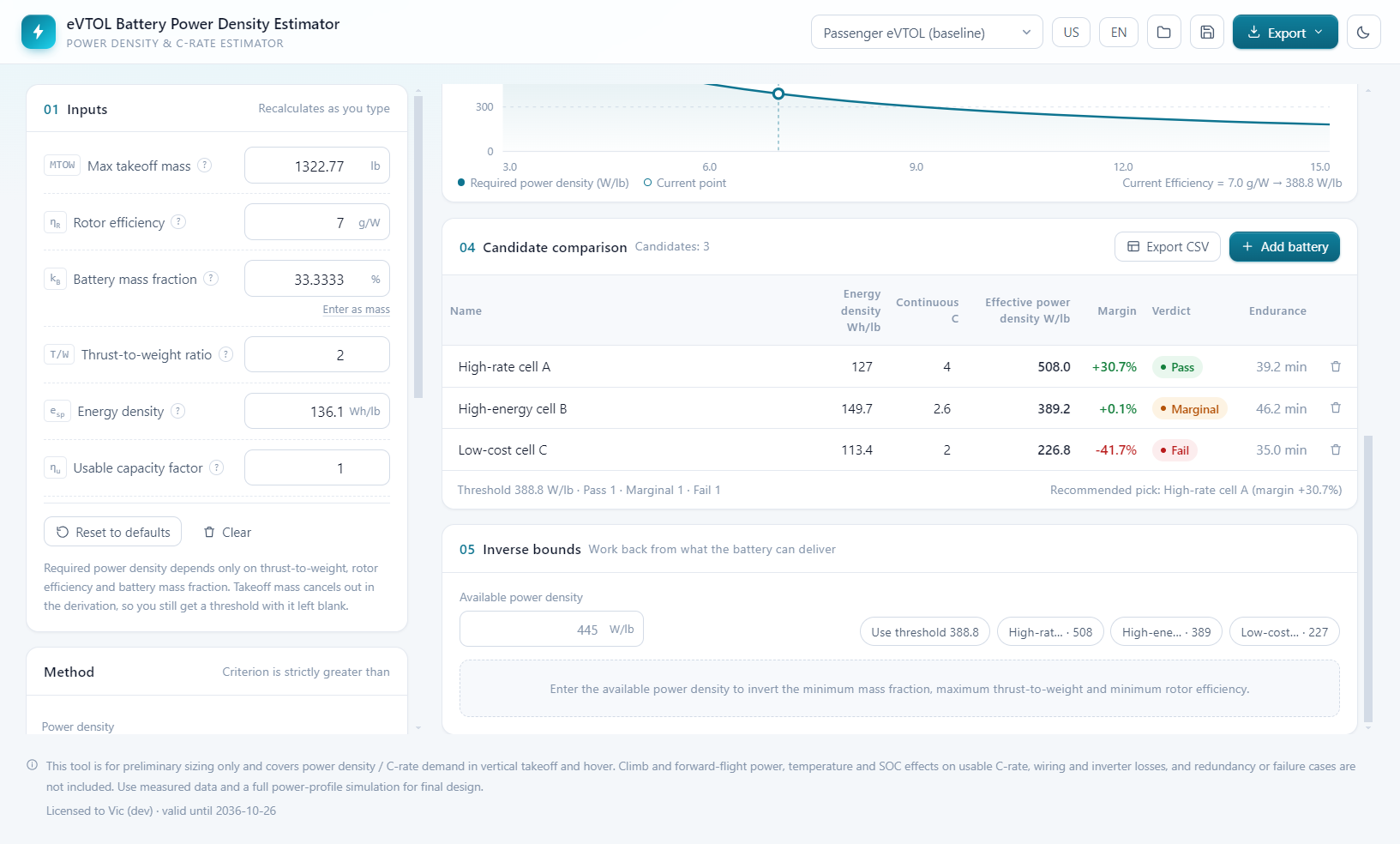
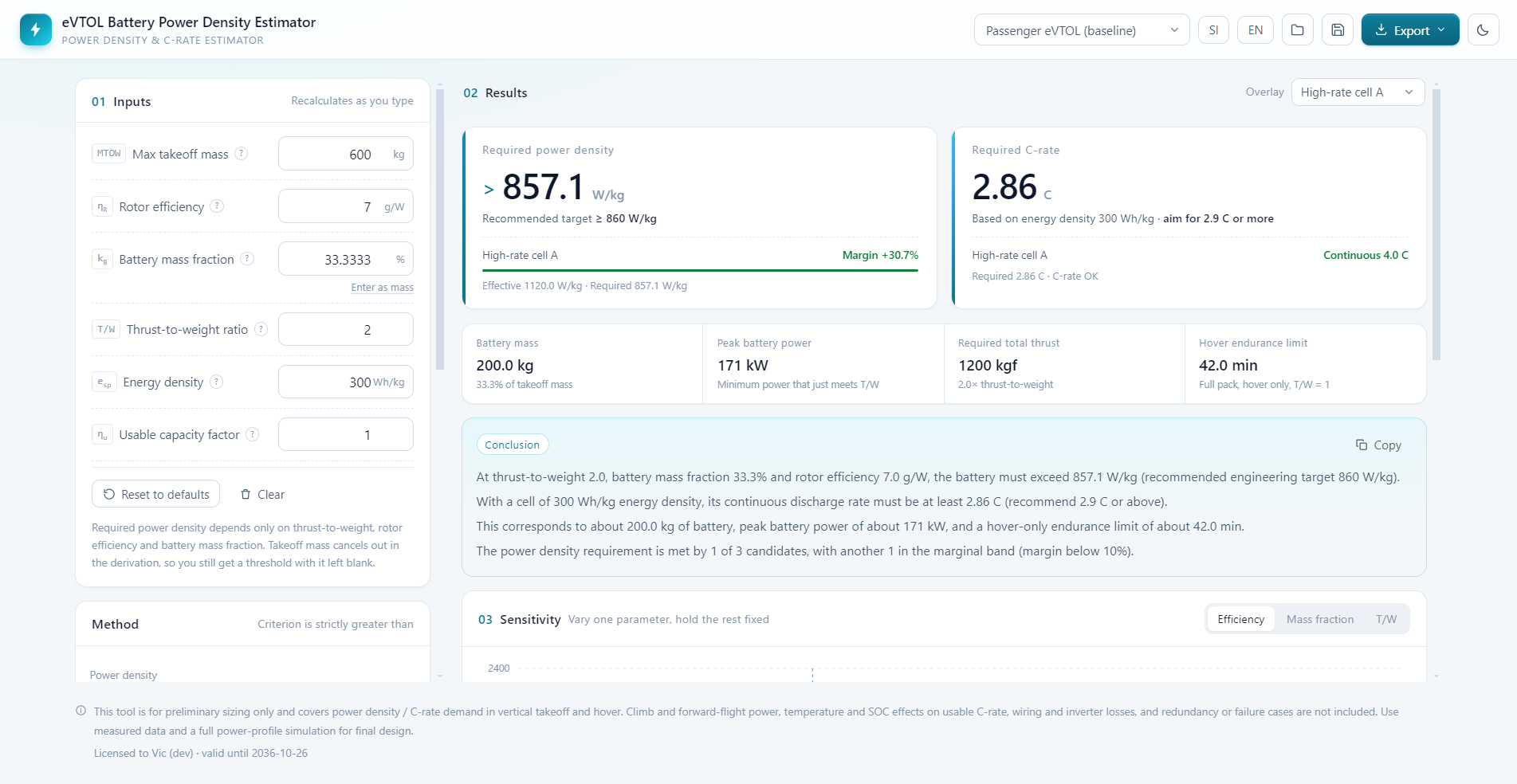
App interface: inputs on the left, results and candidate comparison on the right
6 → 3aircraft inputs → battery answer
857.1 W/kg600 kg baseline: derived power density
0network calls / data uploaded
4built-in presets, incl. logistics and consumer

Why this step is hard

Between aircraft numbers and battery spec, there is no standard answer

SC-VTOL states the margin; a datasheet states the measured curve. The step that turns aircraft parameters into “how many W/kg and how much C does the cell need” has no tool and no formula book — it is judgement built from programme experience.

Few people

Very few can do it

Usually worked by hand by a chief designer or powertrain lead who has taken a full programme through. Without that person the project stalls here — not for lack of will, but for lack of a convention to compute with.

±20%

Conventions differ

Give two engineers the same aircraft numbers and their assumptions diverge — answers can land 20% apart. In review everyone sounds right; nobody can be checked.

×10 rounds

New configuration, whole chain again

Ten parameter changes a day is normal. Each one means recomputing thresholds, re-ranking candidates and redrawing curves — the hours an engineer can least afford to lose.

Six capabilities

One chain, from derivation to decision

Not just a number: derivation, comparison, inverse questions and the write-up all share one convention.

01

Aircraft-to-battery derivation

Enter mass, thrust-to-weight, rotor efficiency and battery mass fraction; get required power density, required C-rate and hover endurance — with every assumption listed in the report.

The step only a few engineers can do, now a process the team can re-run

02

Candidate comparison

Effective power density is esp × continuous C-rate, with pass / marginal / fail verdicts at a 10% margin.

One verdict convention — results are comparable across engineers

03

Sensitivity sweep

Hold everything else fixed, sweep one variable (efficiency, mass fraction, T/W) and see its effect on the threshold.

Which parameter dominates the design space — answerable

04

Inverse bounds

Given what the cell can actually deliver, solve for the minimum mass fraction, maximum T/W and minimum rotor efficiency.

From “does it work” to “which way to move the parameters”

05

Recompute on change

Change any input and the three results, candidate verdicts and curves refresh together — no second spreadsheet.

Time goes to judgement, not to recalculation

06

Report, units and languages

One-click PDF (inputs, derivation, comparison, curves, conclusion) or CSV; SI internally, metric or imperial on screen, Chinese and English sharing one convention.

Review material written for you, fully traceable
Offline by design — a procurement gate, not a feature

No network requests, no telemetry, no design data leaves the machine. Deployable in restricted, defence and air-gapped environments; licence checks run locally with no activation server.

0 network calls

Design baselines

Four baselines, from 2 kg to 1.5 t

Parameters from typical configurations. Each card is the full output of the same chain: what the cell has to reach in that airframe.

The three figures are: required power density · required C-rate · hover endurance limit.

01

Passenger eVTOL · baseline

600 kg class passenger configuration and the default preset — a quick check on whether current cells can carry hover power.

MTOW
600 kg
η_R
7 g/W
k_B
33.3%
T/W
2.0
e_sp
300 Wh/kg
η_u
1.0
857W/kg
2.86C
42.0min
02

Passenger eVTOL · conservative

1.5 t class with conservative rotor efficiency and mass fraction — the risk upper bound for early concepts.

MTOW
1500 kg
η_R
6 g/W
k_B
30.0%
T/W
2.2
e_sp
280 Wh/kg
η_u
0.90
1222W/kg
4.37C
27.2min
03

Logistics drone

80 kg class platform: higher mass fraction, lower T/W, matching light commercial airframes.

MTOW
80 kg
η_R
7 g/W
k_B
35.0%
T/W
1.8
e_sp
250 Wh/kg
η_u
1.0
735W/kg
2.94C
36.8min
04

Consumer multirotor

2 kg class platform: highest efficiency and mass fraction, typical of small multirotors.

MTOW
2 kg
η_R
7 g/W
k_B
40.0%
T/W
2.0
e_sp
200 Wh/kg
η_u
1.0
714W/kg
3.57C
33.6min

Interface and reports

One convention, across UI, report and exports

Fixed two-column layout: inputs stay put on the left while results and the candidate table scroll independently.

Who it is for

Where it fits in the workflow

eVTOL chief designersJudge cell feasibility as soon as the aircraft numbers land
Battery selection engineersSide-by-side cell comparison with margins
Reviewers and managersVerify quickly why a pack concept holds up
Consultants and studiesStandardised, reproducible sizing results

Licensing

Pay once, use it permanently

¥600 per licence, one device. Activate locally with a key — no network afterwards, no subscription, no expiry.

Single device · perpetual
¥600 / licence

One-time payment. Activates locally and keeps working.

Buy licence
  • All features: live estimates, candidate comparison, sensitivity, inverse bounds
  • PDF reports and CSV export
  • Bilingual interface and reports
  • Metric / imperial toggle
  • Offline activation — no network, no data uploads
  • Four configuration presets; projects save and reopen
  • Perpetual licence — no subscription, no renewal

Aircraft numbers fixed? The battery requirement should not be a guess.

Windows 10 / 11 · 76 MB single file · no installer. Enter your licence key on first launch, then work offline indefinitely.